Showing posts with label Albert Hadley. Show all posts

Friday, April 27, 2012

Hinson reemerges with new fabrics

Hinson's back in the textile arena with a long-awaited collection of silks and ikats, available exclusively through Donghia showrooms.


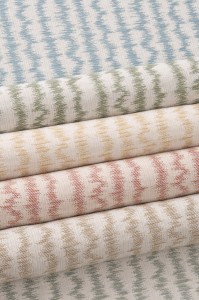
Vienna (pictured above) is a textured silk woven in India with viscose, which lends strength. The understated slubby texture lends a slightly more casual effect. Available in more than ten colors.


Diffusion Taffeta is woven in India of 100% silk. It has a prominent strie which is most pronounced in the deeper colorways. Available in 24 colors, it is ideal for draperies and, when backed, can be used as upholstery:


Harding Ikat is a modern interpretation of the classic pattern, done without the traditional feathery edges that define ikats. In Harding, they are like electric waves. The cotton-rayon blend is perfect for upholstery and curtain and is available in six colors:


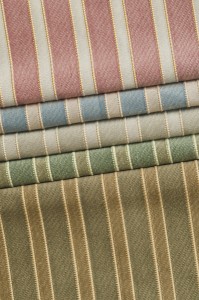
Pavillion silk stripe epitomizes elegance and a classic color palette with alternating width stripes:


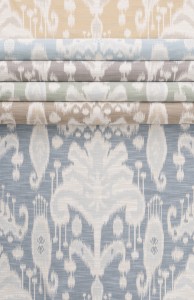
Monroe Ikat is now available in additional colors, at a very attractive price point:


Don't forget, Hinson is also the exclusive source of Albert Hadley's fabrics and wall coverings.

Thursday, April 5, 2012

Remembering Albert Hadley, 1920-2012

The interior design community has lost one of its favorite stars. Albert Hadley died at the age of 91 in his home state on March 29, at his sister's home in Nashville. He had been the Lifetime Achievement recipient at the DDB's Stars of Design last fall.
His clients over a career that spanned six decades included illustrious names like Astor, Rockefeller, Getty, Whitney and Mallon, as well as former Vice-President Al Gore. His talent was first spotted by Van Day Truex when he was a student at Parsons; he was offered a teaching job there upon his graduation in 1949. For several years he worked for Eleanor Brown at McMillen before Truex introduced him to Sister Parish in 1962. His first project: curtains for the Kennedy White House breakfast room. They would later partner in the firm Parish-Hadley. Their collaboration continued for 33 years until Parish's death in 1994, although Hadley continued to run the business until 1999. Among the top talent he fostered during his career: Bunny Williams, Thomas Jayne, Mariette Himes Gomez and David Easton. He continued to work into his 80s, always knows for his broad knowledge of design history and sense of order, both architectural and decorative.
Revisit our three-part series on our afternoon with Hadley from last October.
Photo: Albert Hadley at home in New York. Fernando Bengoechea/Beateworks/Corbis Outline from the New York Times


Thursday, October 13, 2011

Meet the Designer: An Afternoon with Albert Hadley (Part 3)

Before adjourning our afternoon with Albert Hadley, we asked him what words or advice he would share with a new designer today, given the current economic and social climate. His spectacular advice was prefaced with his thoughts on how design has changed since he entered the arena and the many challenges that follow such changes.


"It's very interesting, I think that the normal change we all recognize in society and in the world influences not only the design world, which has been influenced all the way through, but the world as we know it. The design world has changed enormously, especially in the last few years. Until recently, everything was done as I have described it—by carrier, by seeing, by personal involvement. Today, the fact that one can go online and learn everything about everything, shop without seeing, and be involved without being involved has made a big difference in society and the way people live. People don't live today the way they used to and money has nothing to do with it.


"I was thinking about it the other day, and one of the great things that's missing in our society today is one person and one book. That person was Emily Post and that book was Etiquette. Her book of etiquette was a bible for society up until a fairly short time ago and Mrs. Post was thought of as the arbiter of not only good taste, but also civilized living. It is a document that civilized people in this country and in others followed, even for the simplest things like how to write a 'thank-you' note to be sure you were doing it properly. It made life more attractive and more substantial. I think the fact that there was something to base yourself on was very important. That's gone now; it'll never come back. We now seem to have everything we need to go beyond what we know and continue it."


Albert said that society's changes have had an enormous impact on interior design and have made a big difference in the attitude of designers, especially those just starting out.


"It might be said that a lot of young designers don't have the background that young designers were required to have when I began. I believe that if you're going to be a creative person and if you're working with people, the more you know about the history of design and this art, the better off you are. These subjects must be known because where we are today is a reflection of where we've been. I don't think it's enough to acknowledge it and forget it because I don't think we're ever going to completely forget it. At least we hope! We hope there's more to it than that."


"I've always encouraged the young people I've worked with or any creative person I've come across to be open to things that are stimulating to the imagination," Albert continued. "A lot of it has to do with being visual. Whether you're impressed by the art on the wall—whether you like it or not—there it is and you acknowledge it and think about it and feel something because of it. For a young person who's in this world, the more she knows about what other people are creating, the more she is going to develop."


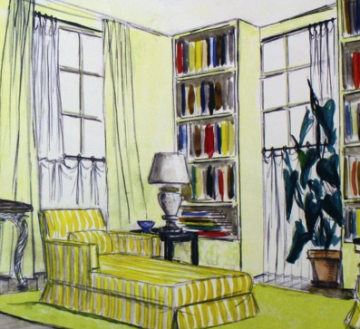
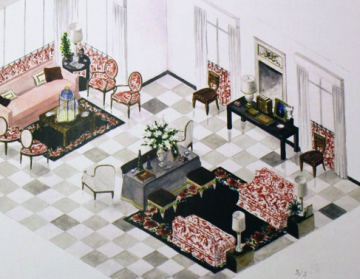
Albert slid his book Albert Hadley: Drawings and the Design Process in front of us and opened it to several of his sketches—the seeds of thought that would later grow into the interiors of some of the most prominent people in the world.


"It's like when this book was put out, the director of the New York School of Interior Design had seen some of my sketches and asked if she could borrow some because she wanted the students to see my process," Albert explained, pointing out both black and white sketches and colorful, detailed drawings alike. "I generally don't project these because I don't consider these fine art. They are short-hand from my imagination, they are sketches that are created to help develop an idea."
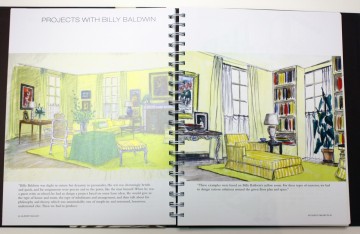


Albert points to a drawing of his with latticework climbing up two walls of a room. "You can see that I've thought I might like the idea of some sort of lattice work but before that happens, it's going to be developed on paper further and it's going to improve or evolve. Every sketch in here was in the process of growing—it might have been very rough or in the middle or just a note of where I'd been or what I'd seen but you can't do this on a computer. You cannot design on a computer. So that's what NYSID's director wanted to show the students, and I'm told that it was very helpful to them. Some of those students approached me to tell me how much it meant to them that they were learning to draw for the first time. They had always seemed to feel that they couldn't draw! I told them that all they needed to do was put pencil to paper and have a thought!"


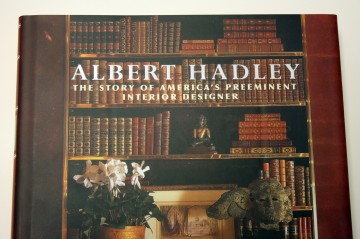
Albert Hadley is the DDB's Stars of Design chosen recipient for the Lifetime Achievement award. To purchase a copy of Albert Hadley: Drawings and the Design Processor Albert Hadley: The Story of America’s Preeminent Interior Designer visit Potterton Books.


Wednesday, October 12, 2011

Meet the Designer: An Afternoon with Albert Hadley (Part 2 of 3)

When we asked Albert Hadley if he had left anything out from the crash course on his career he shared with us, he confirmed that he had given us the very bones of his story.


"That's the fast, sweep through of what I've done and the way I've done it without any explicit details!" said Albert. "I had more ups than downs and I couldn't be happier with what I've done and how I've done it! Coming from Tennessee and landing in New York, I was exposed to the best of the best, through and through. While my design has nothing to do with location, where I came from and where I ended up certainly afforded me a taste, style and perspective that I look back on and feel was the very best for me and my path. What I did was become totally enmeshed in a project and that's why I enjoyed it so much. That's why I think I've had the success that I've had because I really did put my all into it.


"Each project is a very personal thing and has very little to do with trends as far as I'm concerned," Albert said. "I've never been involved in trends or fashions—maybe what's fashionable but that's never been a priority. I think it's a very serious business and one that takes concentration and dedication to both the physical situation, meaning the architecture, and the people who are personally involved—the owners, the habitants."


Asking what his own personal homes were like, Albert laughed and wasted no time explaining that his place was nothing but a mess. "I kid of course,” he said. “My things are very simple and orderly. I think that the design in my personal spaces is not overly decorated, comfortable, not totally a wreck but realistic," said Albert. "I've looked up to so many designers and continue to do so today. I look up to all of them, really, because all of the people that I talk to and all of the people that I met when I came to New York City from the beginning were people who I admired enormously. They then became friends over the years, which is really special. Of course, there were many designers who have come out of Parish-Hadley as well, a number of them, who are still friends and people I still care about as designers. There's quite a list of people I admire and there are lots of people who have nothing to do with our business but are talented in their own regard who I also admire. It's a long list!"


"Another inspiration for me was New York City. That's why I felt so strongly about moving from Tennessee to the city early on," Albert continued . "I've always enjoyed being in London, the first place I traveled to because of my time in the service.  Whenever I've been there, I have friends there and I've certainly known and followed the suppliers and dealers there. But the same is true with any other city. It's a favorite and I don't get there often enough. I've spent time in Paris, I've spent time in Italy and around Europe but New York City has been my main interest and really, my home. When I moved here, I came here to make it my stomping grounds—and I think I did just that!"


Check back with GoDesignGo tomorrow when Albert Hadley shares his thoughts on how the world of interior design has changed since he began and what advice he would give to beginning designers now.

Tuesday, October 11, 2011

Meet the Designer: An Afternoon with Albert Hadley (Part 1 of 3)

It's not everyday that we get the chance to spend an afternoon with an interior design icon and legend such as Albert Hadley, but last week that's just what we did. We gave Albert our full attention as he took us through the time line of his illustrious career and shed light on how he got to where he is now.


“I started my career working in Nashville. I was lucky to start out working with a furniture store that my family had known; it was my first experience of selling and I was pretending to be a decorator! I was clearly very young!" Albert said. "When I graduated from school, I was fortunate enough to then work for one of the top decorators in the South, Herbert Rogers, who was based in Nashville, Tennessee. He was the big guy there, so I had a wonderful year or so before I left for the military. I went into the service in Europe, and of course I was interested in seeing as much as I could when I wasn't working. I was stationed in London, so I was able to see some exciting things there.


"When I came back, it wasn't long before I had decided that I intensely wanted to be in New York City—it was where  the design work that I had been following was. In those days, as it still is a bit today, interior design was seen through publications so I knew of every important person working!" Albert admitted, laughing about the ambitious youngster he had been. "It's still a mystery how I was able to be so outgoing and outspoken amongst such icons of design, but I made it my point to meet them all! I explained that I wasn't looking for a job and that I just simply wanted to meet them. Strangely enough, all without exception were open to meeting me. I started with the top ones of the time like Rose Cummings and Billy Baldwin—you know, the big firms."


Albert's meetings with the New York-based players of design were only the beginning of his illustrious path to becoming one of them. Upon meeting Mrs. Archibald Brown of McMillen, Inc. (previously Mrs. McMillen) Albert was faced with her assertion that he was certainly looking for a job. Mrs. Miller notified Albert that she wouldn't hire anybody unless they had been to Parson's The New School for Design, because she was on the board and a good friend of the school's.


"So I applied for the six-week summer course at Parson's, and I got in. Shortly thereafter I was awarded a scholarship so I stayed for the full course.  In three year's time, after I graduated, I was then offered a position there to teach," said Albert. "I then taught there for five years and from there I went off on my own and started my own business in New York City. I was fortunate enough to have more than decent clients and did reasonably well!


"I had my own business and studio apartment on East 57th street for a few years before being offered a job with McMillan Inc., one of the most prestigious decorating firms at the time. I accepted and went down as the only male decorator on the staff. Mrs. Brown and a group of lady decorators and I got along with them very well! I accomplished quite a lot and they were very helpful and supportive.


"The director of Parson's School of Design, a great friend of Mrs. Brown’s, telephoned me one morning with an opportunity. He said that he had sat next to Mrs. Henry Parish the night before and did I know her? I said that I had met her a few times before and he told me that she was more or less just finished with her work at the White House and she was hoping to find somebody to go into business with and she was waiting for me to call! We met two or three times and I was hired to start on the first of the following year, four months later."


Albert worked with Mrs. Henry Parish II until he was made partner in 1962. Parish-Hadley went on for the rest of Mrs. Parish's life.  A short time later, at the turn of the century, Albert closed Parish-Hadley and opened his business under his own name, which closed only this past year.


Stay tuned to GoDesignGo for more with Albert Hadley and his path through the interior design world to today.

Wednesday, September 29, 2010

Plushy, Cushy Chenilles

Hinson launches its first new fabric collection at Brunschwig & Fils. Plushy, cushy chenilles in the 'now' neutrals ranging from ivory to beige and camel...from cream to sand and stone.  Also new at Hinson...gossamer sheers...light and filmy...small windowpane, the look of pure linen stripes and small classic satin stripes.  All in easy-care polyester.


Another trendsetter...Brooke which is an adaptation of Albert Hadley's large-scale Russell which was inspired by an 18th century crewel. This new version is smaller in scale and delineated by the addition of patterned stripes between the vines.

New from Hinson...a marvellous melange for upholstery and curtains.


Monday, August 30, 2010

The Great American Decorator

Billy Baldwin
The Great American Decorator
By Adam Lewis
Forward By Albert Hadley


The definitive book on the legendary decorator Billy Baldwin, known as the “Dean of American Decorating”, famous for his classical taste, streamlined modernism and brilliant use of color.  With a forward by Baldwin’s former student, Albert Hadley, and enriched by never-before-published transcripts of four 1974 lectures that Baldwin gave at the Cooper-Hewitt, this is an important book for anyone interested in interior design.